Compare internet plans
Take the quiz to be paired with some of the most relevant internet plans for your needs.










We currently don't have that product, but here are others to consider:
How we picked these

Here's a rapid-fire list of five questions to ask yourself before you start comparing internet plans.
If anything feels a bit fuzzy, don't worry - we'll unpack it all just after.
What type of internet plan are you after? In Australia, you'll generally have access to one or more of these: NBN (including fixed-line, fixed wireless or satellite), home wireless broadband or mobile broadband. What's available depends on where you live.
What's your budget? Our research shows the average broadband bill in Australia is $81 a month, but your cost will depend on the speed you need and which provider you go with. Finder compares 40+ providers, so there's plenty of choice when it comes to price.
What internet speeds do you want? It comes down to how many people are in your home and what you're using the internet for. More users and heavier activities (streaming in 4K, uploading or downloading large files regularly or gaming) usually mean you'll want faster speeds.
How much data do you need? Most internet plans these days come with unlimited data, providing peace of mind. But with mobile broadband or NBN satellite, data caps are more common, so it's important to check that the allowance suits your internet use. Take a look at our guide to get a better idea of how much data you might need.
Contracts or no contracts? Most providers these days offer no lock-in contracts. Just make sure to read the terms and conditions before signing up.

The price gap between the cheapest and priciest broadband providers can top $600 a year, but with so many broadband plans and speed tiers out there, it can be hard to know which one's right for you, especially if all the jargon sounds confusing.
Hi, I'm Mariam, Finder’s tech and utilities expert, and I'm here to help you figure out how to compare internet plans and pick the one that works best for your home and won't break the bank.
Let's start with the basics. In Australia, there are a few main ways to get internet at home. Most people use the NBN, which is the National Broadband Network. That includes fixed line NBN, which most of us have, plus satellite and fixed wireless NBN, which are mainly used in regional and rural areas.
If you can't get NBN, you might have access to a private fibre network like those offered by TPG or GigaComm. Another option is home wireless or mobile broadband, which run on 4G or 5G mobile networks. What's actually available to you will depend on where you live. So, it's worth checking which options are available at your address before comparing. You can use the address tracker on Finder to see what plans you can get. If it's not NBN, we'll show you alternatives.
Once you know the type of connection you can get, the next step is to look at speed. For fixed line NBN, speeds are grouped into tiers like NBN 25, NBN 50, NBN 100 and higher. These help you work out what suits your household.
For example, NBN 25 can be fine for light users or smaller households, while NBN 100 is better for busier homes with three or four people online at once. Your address also determines the type of fixed line NBN connection you have, which will in turn affect what speeds you can get. Some connection types can't go beyond NBN 100, while fibre to the premises, for example, can reach the fastest speeds available all the way up to NBN 2000.
If you're not happy with your NBN connection or you just can't get access to it, home wireless broadband plans have become a really popular alternative, especially on the 5G network as it can hit speeds similar to some NBN plans. The main catch is that not every provider offers it yet and coverage still depends on where you live.
If you want something more portable or your internet needs are pretty light, you could go for a mobile broadband plan. It works similar to your phone plan minus the calls and texts.
Once you've decided on the type of plan, the next thing to look at is data and price. Most internet plans now come with unlimited data, which gives you peace of mind, but with mobile broadband or NBN satellite, data caps are more common. So, make sure your allowance actually fits how you use the internet.
And finally, price. Always, always look out for a deal. Most broadband providers have sign-up offers, think six or even 12-month discounts. Plus, most plans don't have lock-in contracts anymore, so it's easy to switch when a better deal comes along.
And remember to factor in modem costs, too. If you can't bring your own modem or don't already have a compatible one, you might need to get it from your provider. Some will even give you one for free if you stay connected for a certain period or return it after cancelling your plan.
And that's a wrap. Hopefully, you now have a better understanding of how to compare internet plans. Check out the link in the description to shop around for a deal or leave a comment if you have any questions. Bye.
When it comes to picking an internet plan in Australia, you'll usually be looking at one of three main types.
The NBN (National Broadband Network) is what most of us use to get online in Australia.
It's a government-owned network, built and maintained by NBN Co, with plans sold through a range of internet providers.
Since the NBN uses a mix of technologies like fixed-line (available to around 90% of Aussies), fixed wireless, and satellite, your connection type will depend on where you live.
That's why your address plays such a big role when signing up for an NBN plan.

Home wireless broadband has quickly become a popular alternative for those who aren't happy with their NBN connection or can't get access to it.
It runs on the same 4G or 5G mobile networks as your phone, but instead of using a portable device, your provider sends you a modem designed specifically for home use. Just plug it in and you're good to go.
5G home wireless broadband - or 5G home internet for short - can offer speeds similar to some NBN connections.
The main caveat is that fewer providers offer home wireless broadband plans, and availability will depend on your address.
Mobile broadband works similarly to your mobile phone plan, just without the calls and texts.
You can use a data-only SIM in a tablet or phone, or insert it into a Wi-Fi dongle that plugs into a USB port.
Alternatively, you can use a portable Wi-Fi modem (also known as pocket Wi-Fi), which can be handy if you want to create a hotspot for multiple devices.
We calculated potential savings by comparing the prices of the cheapest and most expensive broadband plans in our database over a 12-month period.
| Internet type | Cheapest Plan (provider) | Most expensive plan (provider) | Savings over 12 months |
|---|---|---|---|
| NBN 12 | $49.90 per month (Telsim) | $77 per month (Aussie Broadband) | $397 |
| NBN 25 | $48.99 per month (Arctel) | $97 per month (Telstra) | $528 |
| NBN 50 | $57.99 per month for 6 months, then $75.99 per month (Arctel) | $113 per month (Telstra) | $504 |
| NBN 100 | $69.90 per month for 12 months, then $85.90 per month (Kogan Internet) | $110 per month (AGL) | $445 |
| NBN 500 | $69.90 per month for 12 months, then $85.90 per month (Kogan Internet) | $107 per month (AGL) | $445 |
| NBN 750 | $99 per month for 12 months, then $104 per month (Vodafone) | $103.50 per month for 6 months, then $120 per month (Launtel) | $432 |
| NBN 1000 | $78.99 per month for 6 months, then $104.99 per month (Arctel) | $140 per month (Future Broadband) | $576 |
| NBN 2000 | $141 per month for 6 months, then $166 per month (MATE) | $195 per month (E.tel) | $498 |
| 4G Home wireless | $39 per month for 12 months, then $59 per month (Optus) | $55.90 per month (Yomojo) | $203 |
| 5G home wireless (50Mbps) | $29.99 per month for 6 months, then $59.99 per month (TPG) | $80 per month (Telstra) | $420 |
| 5G home wireless (100Mbps) | $34.99 per month for 6 months, then $64.99 per month (TPG) | $75.90 per month (Yomojo) | $311 |
| Mobile broadband | $20 per month (Vodafone) | $79 per month (Vodafone) | $768 |
People often zone out when it comes to internet speeds because really, who cares about megabits per second (Mbps)? Most of us just want to know if it's good enough for our internet needs.
We get it. So here's a simple breakdown of how to choose between NBN and home wireless broadband speeds.
Selecting the right NBN speed tier comes down to how many people are in your household and what you want to do.





Don't forget, your NBN connection will determine what speeds you can get.
Only those on a Fibre to the Premises (FTTP) or Hybrid Fibre Coaxial (HFC) NBN connection, will be able to get speeds faster than NBN 100.
Read our detailed guide on NBN speed tiers.
Your speeds on a 4G home wireless broadband plan will normally cap out at 25Mbps.
For 5G home internet, providers tend to lean towards plans with either a maximum of 50Mbps or 100Mbps speeds.
Some providers, like Telstra and Optus offer faster or even uncapped speeds.
Awards are a great way to narrow down the best of the best. See which providers topped this year's broadband awards.
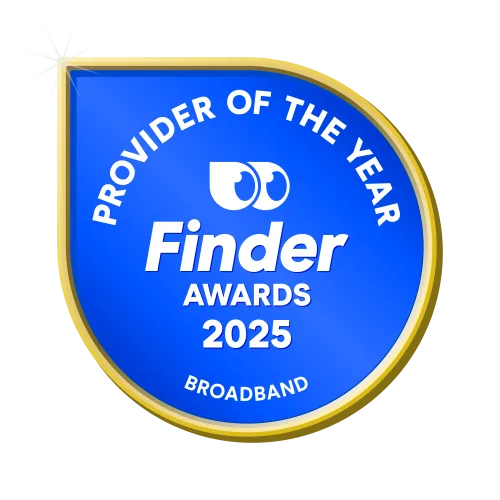
TPG has claimed Finder's Provider of the Year Award for broadband with a cracking score of 9.9. It's mostly to do with competitive pricing across the majority of its NBN and home wireless internet plans that come with no lock-in contracts, speed reliability and multiple customer support options. TPG also scored highly for customer experience, value, reliability, and trustworthiness.
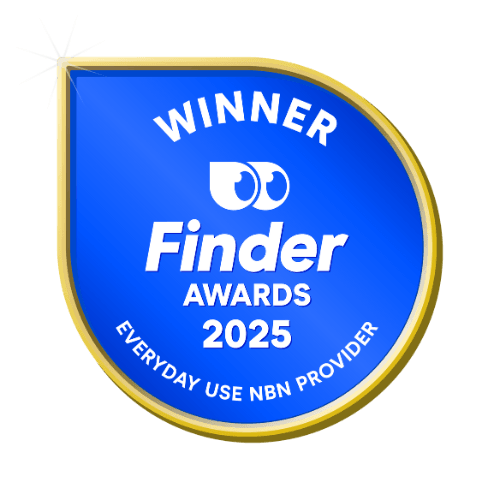
Dodo knocked it out of the park with its competitive pricing for everyday speeds (NBN 50). You can BYO or buy one with multiple payment options to suit your needs. There's also the option to bundle internet and energy with Dodo to save up to $10 a month.
Dodo takes home another win for delivering fast speeds at a great price point. Its recent 12-month discounts have given it the edge this year. It's also been in the top five in the last few ACCC reports, which measure speed reliability on a quarterly basis.
SpinTel earns its first win for Best Budget NBN Provider by delivering the maximum typical evening speeds available on an NBN 25 plan, coupled with one of the lowest prices in this category.

In addition to scoring well for speed reliability in the ACCC's recent broadband performance report, TPG's NBN 250 plan offers solid value at just under $100 a month. New customers can often take advantage of six-month sign-up discounts, bringing the price down to under $85 a month for the first half of the year.
Aussie Broadband knocked it out of the park for the fourth year in a row as the most loved broadband provider by Australians. It got the highest overall score of 4.26 out of 5.
We analyse over 300 internet plans from 40+ providers and compare them side by side to produce a straightforward score out of 10. Products are assessed for their costs over a two year period, download speeds, data limits and modem costs. We also assess providers for customer support features offered, while also assigning each provider a customer satisfaction score generated from our annual survey.
Products must be active residential NBN, 5G or 4G plans to be eligible for a score. NBN plans are grouped into speed tiers and scored within their applicable tier. The speed tiers NBN products are grouped into are NBN 25 Mbps or lower, NBN 50 Mbps to 100 Mbps, NBN 250 Mbps to 750 Mbps and NBN 1000 Mbps or higher.
Optus 5G home internet plans offer unlimited data and easy plug-and-play setup.
Skip the upfront costs with an internet plan that includes zero setup fees. Bring your own modem or snag one for $0 with some providers by staying connected for a set time.
4G home internet is a great alternative if the NBN isn’t available or isn’t working for you and you don't need fast speeds.
You don't have to cheap out to save money on your broadband.
Discounted prices for unlimited internet plans start at around $30 a month with no lock-in contracts.
Our review breaks down how Dodo’s NBN plans stack up for price, speed, value and customer service.
Check out our top 9 picks across NBN and home wireless broadband.
MATE offers straightforward NBN plans with Australia-based customer service. Find out if it's right for you.
With 20 years of experience in the Australian market, iPrimus offers customers a compelling, quality broadband service.
SpinTel offers simple and affordable internet plans. Find out if it's right for you in our in-depth review.




i am with Telstra now if I change provider do I have to change current email adress
Hi Duncan,
In most cases you can keep your current Telstra/BigPond email address even if you switch your internet provider. For example, if you have an old @bigpond.com or @telstra.com address, Telstra says existing accounts will continue to be supported even if you move.
According to Telstra Support: If you leave Telstra, you can keep your Telstra email address by letting them know when you close your account. To keep the email active, you need to use it at least once every 180 days. If your email hasn’t been used for over 180 days, it may be suspended. You would then need to chat with Telstra to reactivate it.
Hope this helps!
I was looking at Optus NBN500 offer that has a bonus Visa reward ending 30th January. If I sign up now, but I select the start date for the plan as 9th February, will I still qualify for the Bonus Visa reward? I have looked at T’s and C’s but am not clear on it, as it mentions something about activating the service within 30 days of sign up?
Hi Peter, yes, you’ll still qualify for the reward as the start date of your plan is within the 30-day period. Hope this helps!
We don’t have NBN available to us. What networks would be available to us.
Hi Rose, a close alternative is 5G home internet – you can compare NBN alternatives in our guide: https://www.finder.com.au/broadband-plans/nbn/nbn-alternatives. Hope this helps!
We go overseas each year but still pay for our non broadband when away. Do non contract ( month to month ) plans allow a stop and start service or is more complicated than thst
Hi Babs,
You may be able to pause your internet service, but it depends on your provider and plan. Some providers offer a temporary hold on your account for extended travel, or you may be able to downgrade your plan to a cheaper/lower plan while you’re away. It’s best to contact the provider directly to inquire about your options.
How do you end a contact with Optus?
Hi Caroline, you can just give them a call and they’ll help you out! Hope this helps.