Default Market Offer and reference price explained
Paying too much for electricity? Understanding the Default Market Offer and reference price can help you find a better deal.

The DMO is the maximum price that electricity retailers can charge for standing offer plans.
We'll get into more detail on standing offers later in the guide, but for now, just know these plans usually apply to a small group of people who don't compare or shop around for a better energy deal.
The DMO is set by the Australian Energy Regulator (AER) each year on 1 July and applies to households and small businesses in NSW, SA, and South East QLD.
It acts as a safety net to prevent retailers from overcharging customers on standing offer plans.
The DMO takes a range of costs into account before a final figure is set each year. It reflects what it typically costs a retailer to supply electricity to a household or small business.
This includes wholesale electricity prices, network charges, environmental scheme costs, retail operating expenses and a reasonable profit margin.
The reference price is essentially the same as the DMO, but it's just the label used on provider and comparison websites (such as Finder) to compare all energy offers against the DMO.
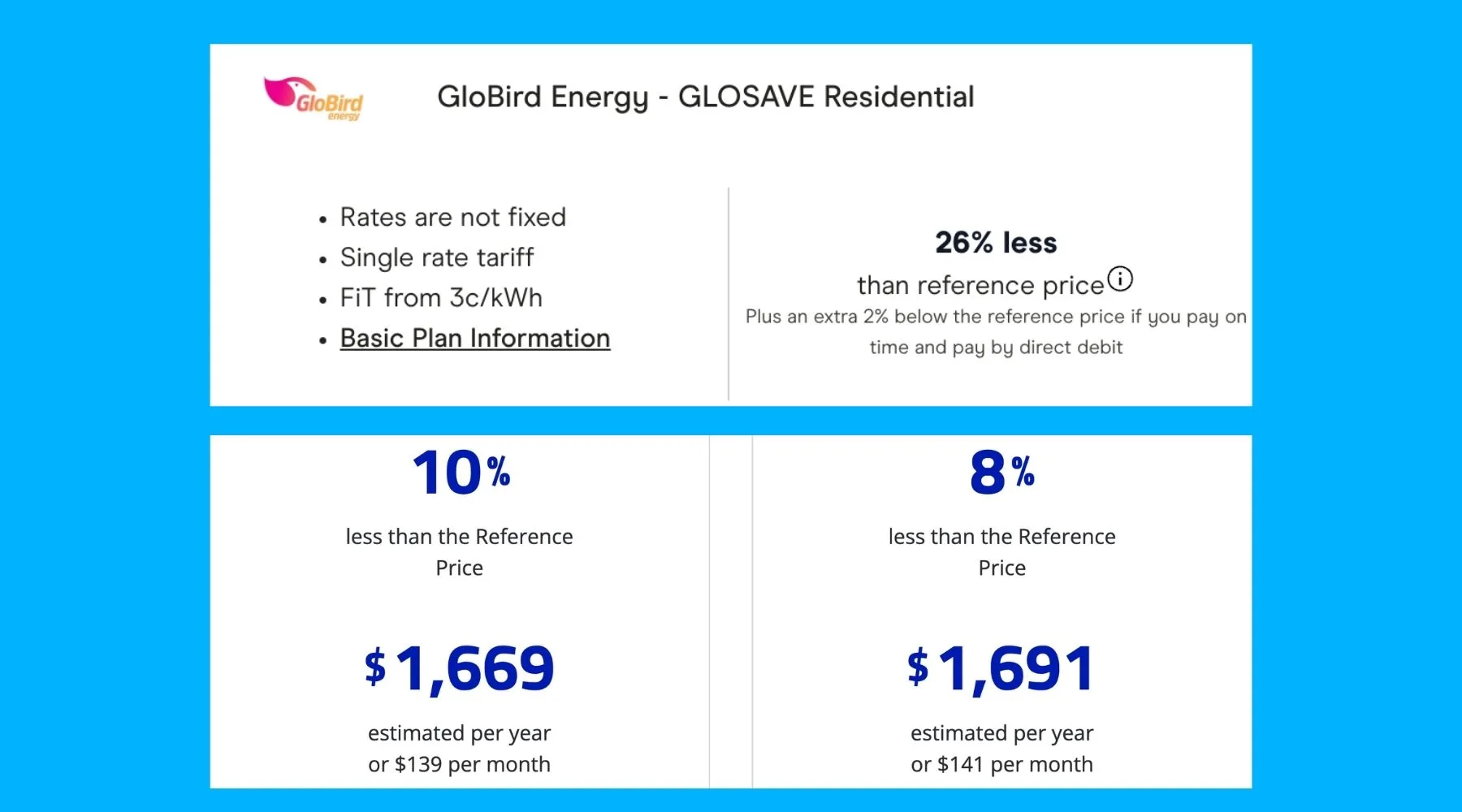
These offers are usually displayed as a percentage above or below the reference price.
So yes, they're both similar, but think of the DMO as the price ceiling and the reference price as a comparison tool.
Here's an example of how it can look:
Because Victoria's energy market is regulated by the Essential Services Commission, some of the terminology and rules differ slightly.
Instead of the DMO, Victoria has the VDO. They serve essentially the same purpose.
The electricity markets in Tasmania, Western Australia, Northern Territory, regional Queensland and the Australian Capital Territory are regulated by state governments and other authorities.
They'll have their own rules and regulations around pricing and customer protections.
If you live in these parts of the country, it's important to check the local energy regulator's guidelines to understand your electricity plan.
Haven't shopped around for a new electricity plan in over 12 months? Compare energy plans to find a cheaper deal.
Unfortunately, both DMO and VDO price have increased this year by as much as $280, with NSW seeing the biggest rise.
Here's a look at the DMO prices first, including rates for customers on a controlled load tariff, which applies to appliances like hot water systems or pool pumps that are metered separately.
| State/Network | Without controlled load (Residential) | With controlled load (Residential) | Small business without controlled load |
|---|---|---|---|
| NSW (Ausgrid) | $1,965 (8.6% or +$155) | $2,717 (8.3% or +$208) | $4,977 (7.9% or +$365) |
| NSW (Endeavour) | $2,411 (8.5% or +$188) | $3,072 (9.7% or +$271) | $4,775 (8% or +$353) |
| NSW (Essential) | $2,741 (9.1% or +$228) | $3,211 (9.6% or +$280) | $6,222 (8.5% or +$489) |
| QLD (Energex) | $2,143 (3.7% or +$77) | $2,425 (0.5% or +$11) | $4,294 (4.2% or +$33) |
| SA (SA Power Networks) | $2,301 (3.2% or +$71) | $2,821 (2.3% or +$64) | $5,541 (3.5% or +$189) |
Here's a look at VDO prices for 2025-26:
| AusNet | CitiPower | Jemena | Powercor | United Energy | Victorian average | |
|---|---|---|---|---|---|---|
| 2024–25 (final decision) | $1,902 | $1,456 | $1,664 | $1,699 | $1,554 | $1,655 |
| 2025–26 (final decision) | $1,908 | $1,546 | $1,638 | $1,703 | $1,579 | $1,675 |
| Change in $ | $6 | $90 | -$26 | $4 | $25 | $20 |
| Change in % | 0.3% | 6.2% | -1.6% | 0.2% | 1.6% | 1.2% |
For small businesses on a VDO, annual prices will rise by $90 across the five distribution zones to $3,620.
Standing offers are the default electricity plans customers are put on if they don't actively choose a plan.
The price is set in line with the DMO or VDO.
Market offers are designed by energy retailers and are more often than not cheaper than the standing offer.
With these differences in mind, it's always better to choose a market offer that's cheaper than the standing offer. Check your last bill or contact your energy provider if you don't know what type of plan you're currently on.
To highlight the difference even more, single-rate market offers listed in Finder's database can be as much as 26–28% lower than the reference price or VDO.
So shopping around for a better energy deal could save you hundreds of dollars. Start comparing!
Energy giants are asking for the Solar Sharer offer to be delayed.
Compare the cheapest electricity and gas plans available in your state.
Get bonus rewards points and bill credit with some of the best energy offers available this month.
Check your quarterly electricity and gas bill against the average in your state.
You have the power to switch energy plans in Adelaide and the rest of South Australia. Luckily it only takes minutes to hunt down the cheapest options with us.
Buy your electricity with Powershop and get flexible power options, green-friendly energy and online discounts.
There’s no time for snoozing. Hunt down the best electricity and gas providers in QLD with us so you can switch and save.
Whether you're in Sydney or regional NSW, comparing energy plans doesn't have to be a headache.
Don’t snooze. It’ll take just a few quick clicks to start comparing electricity and gas plans in Victoria and Melbourne.
Residents of the ACT have several electricity and gas providers to choose from.